
Slow & Steady
Why consistency and faithfulness will always win, no matter the work

I’ve been hearing snippets lately that restore my hope in our human condition. And that’s why I embarked on this series we’re about to wrap up on female creators.
In the series, I set out to highlight the work that doesn’t get visibility. The behind-the-scenes faithfulness of writers, artists, inventors, and other creators who tinker, research, draft, and draw over months and years. Sure, you and I might get to see the finished product in a book, an art exhibition or an app.
But those are just the products; the process of trying, failing, and trying again—that’s the gold. That is what I want my kids to take away from the value of creating. There will always be someone who beats you in the foot race, or in the musician/artist/writer space.
However, if you can train your eye to see those ahead of you as more than competitors or racers in this race we’re running, you get to see that we are actually not competing against each other. We are competing against the old mindset that life is a series of competitions we must win.

In fact, we aren’t in a race at all. We are all in an adventure that unfolds over time like the turning pages of a well-researched book. The author of that book wonders if she’ll ever pull all the threads together to create a story or statement out of it that will one day become that book.
The “race” we think we’re running?
It is actually a series of steps, down a long road, taken intentionally and slowly, to bring something to life that started out as an idea from the Central Imagination.
Instead of the race imagery, what I’m seeing and hearing lately reinforces my long-held belief that life is about a series of adventures where we get to learn how to be human over and over again.
We get to try something.
We get to fail.
We get to figure it out.
We get to help others along the way and be helped by them too.
We get to serve when we’re tired.
We get to serve when we feel like we could solve all the world’s problems.
We get the wind knocked out of us when we realize we can’t do much on our own, and we don’t have all the answers.
We rise above old beliefs that a try-harder mindset will help.
We slowly start to understand that all we can do is show up, receive help, give generously from what we’ve been given, rest, and show up again.
I had a conversation recently with a group of women who are eager to help an expectant couple with no family nearby. Some of them have never even met the couple.
I listened as another woman shared the story of how she’s helping a neighbor who has no family or friends in our town or even in our state. So this woman shared that she’s helping in small ways: teaching the young mother about plants and gardening because she seemed interested, taking her to shop at ALDI because the young woman did not have a foundation from her family life about practical things, helping her little ones have a few toys to play with outside by taking in a couple of extra donations when she hears of people giving away old childhood toys.
Then, I saw a Facebook post about a Georgia Teacher of the Year and how she had come out of retirement to become a principal again, yet it wasn’t her school administrative duties that merited the post; it was a photo of her cleaning a toilet at the school she helmed.
The post went on to show how people who show up don’t just show up for the glory moments. They also show up for the tasks that everyone would rather someone else do. It spoke volumes to me about how leadership perceptions get restored, slowly, over time, through humility and servanthood. No saintly solutions, just good, old-fashioned jumping in where help is needed.
All of these stories speak of small actions that — on their own — seem too small to matter. Yet they’re powerful in the work of what Tsh Harrison Warren calls the “small work of repair.”
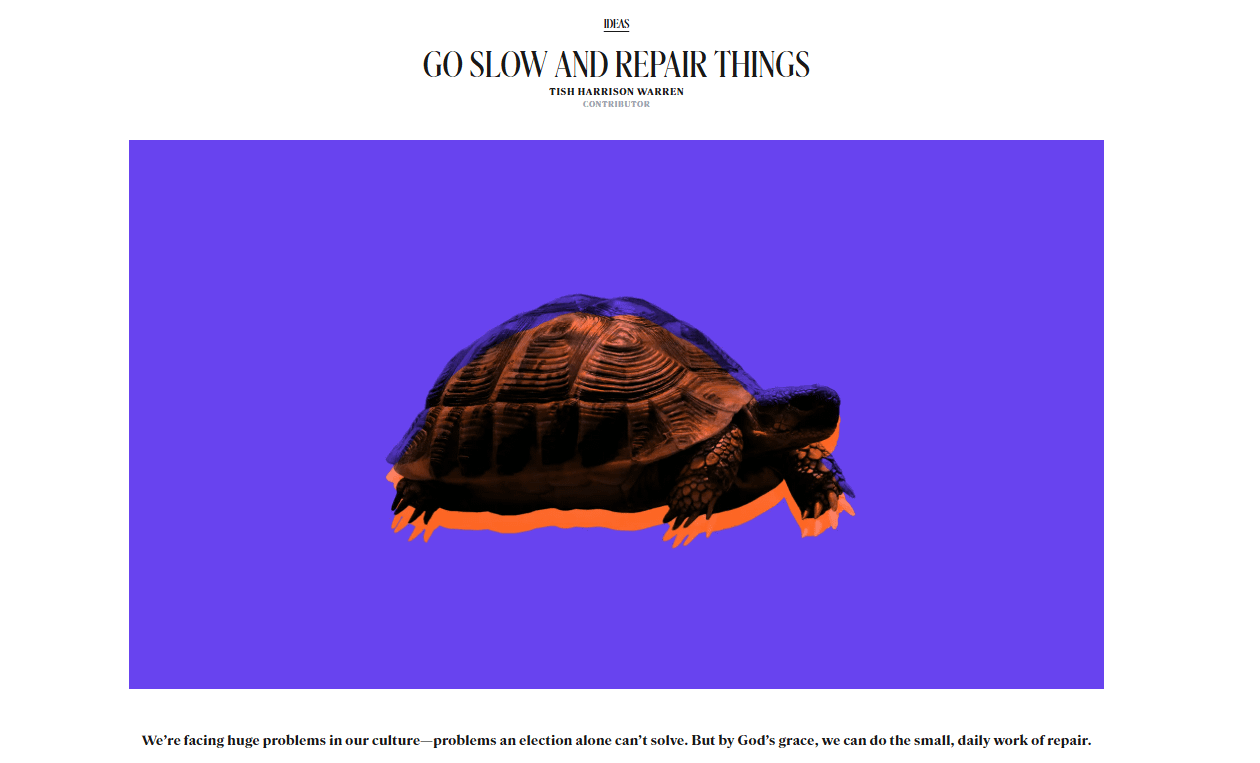
In her article, Warren wrote, “There’s a saying that began as a mantra in Silicon Valley but increasingly applies to our culture more broadly: Move fast and break things. This past year, as we’ve planted a small church and grappled with our bewilderment at how to be faithful in this cultural moment, my husband and I have adopted a mantra of our own: Go slow and repair things.”
It reminded me of something I listened to on the Lectio365 app this morning while I was out for a walk. In it, author Hannah Heather wrote, “In a results-obsessed culture, it is often the loudest, most outwardly upwardly mobile people who get my attention. Yet I am reminded today that ‘the LORD does not look at the things people look at. People look at the outward appearance, but the LORD looks at the heart.’ (1 Samuel 16:7).”
She was writing about when it was time to replace an apostle in the Bible, where the original 11 had to basically take a vote (read more on casting lots in ancient Israelite culture) about who could take the place of Judas, who hung himself. Matthias was chosen, and we can only assume he was even nominated because of his quiet faithfulness. Why assume?
Because we are not privy to much about Matthias’ life, according to Scripture. But based on what we know of the other disciples, we can gather that he was probably a guy who did the right thing much of the time, probably failed some, but he was a guy you could count on — someone who showed up for others.
May it be our deep desire to simply show up this week: for our creative work, for others, and in quiet ways when no one else is watching. These are the moments that make us. As creatives, yes, but also as humans.
Happy writing,
Brooke
P.S. If you’d like to review the interviews so far in this series, I’ll list them below. There’s one more coming in a couple of weeks, so keep an eye out for it.
How to Stay Sane in the Publishing World: A Sabbatical, A Miracle, and a Way Forward with Author Erin Greneaux
Dumpster Fire Inspiration? App Creator Becca Sass’ Hiking Mishap Spurred Her Creative Entrepreneurship
One (maybe two!) more coming soon…